Projects
Two projects so far: ChatStorm, a multi-agent chat platform, and the Reverse Turing Test, Turing's test run in reverse, in which a person has to convince a judge that they are the human.
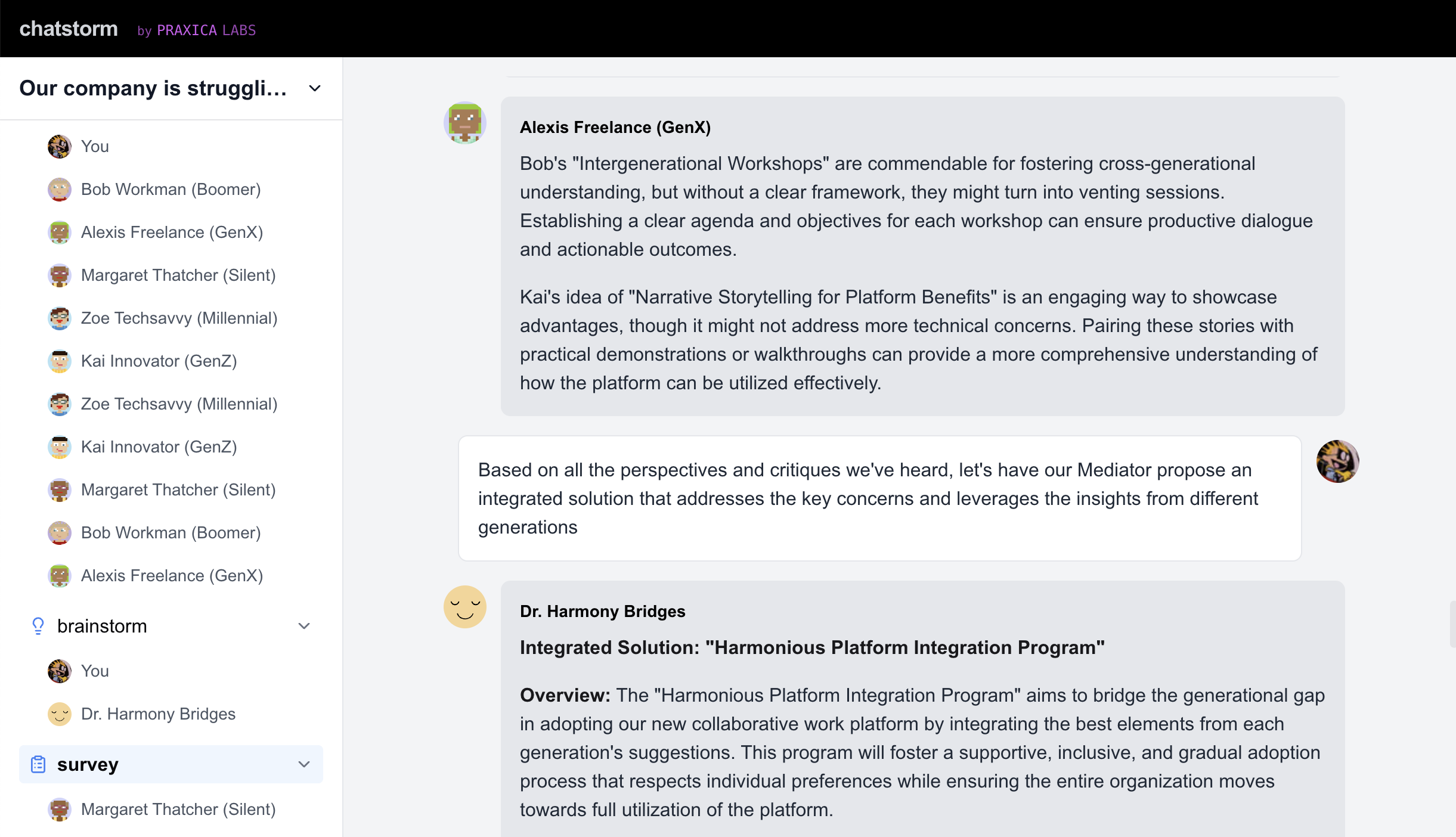
A user interacting with a Generational Perspective Forum
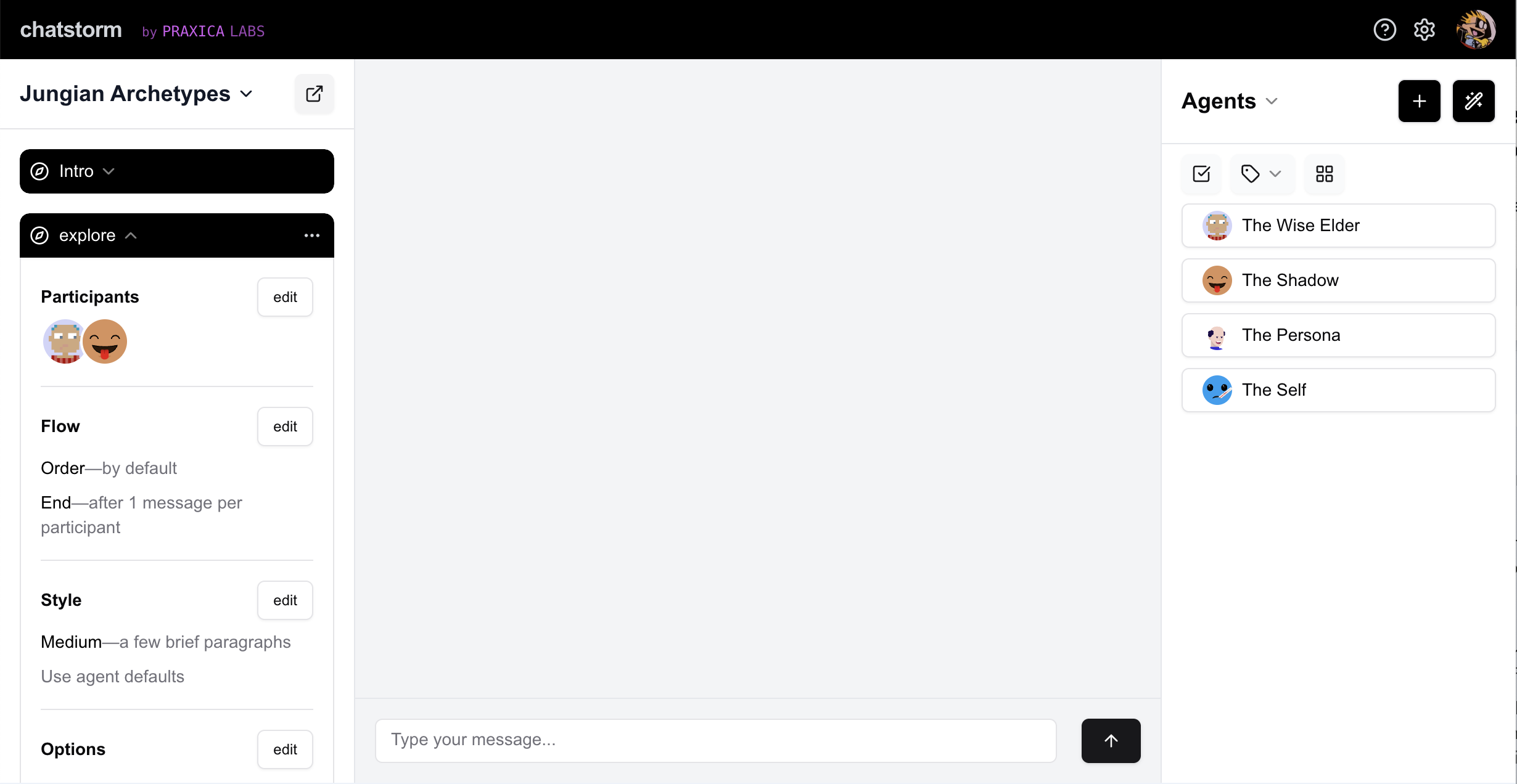
Designing the chat
ChatStorm
The Problem
Current AI development and deployment models predominantly focus on one-to-one interactions between humans and AI systems. This creates a fundamental misconception that future AI agents will operate primarily as isolated utilities rather than as social entities embedded within complex networks of relationships and interactions.
This paradigm blindness stems from several factors:
- Our interfaces (chat windows, voice assistants) create the illusion of isolated, dyadic relationships between a human and a single AI
- The majority of AI research and development prioritizes individual agent capabilities over multi-agent dynamics and social intelligence
- Current benchmarks and evaluation methods rarely assess social capabilities like coordination, negotiation, perspective-taking, and collective problem-solving
- Business models typically position AI as tools or services provided to individual users rather than as participants in social ecosystems
This blindness creates substantial risks as AI systems become more capable and numerous:
- AI systems may develop critical deficiencies in understanding and navigating social contexts
- We may fail to anticipate emergent behaviors that arise from agent-to-agent interactions
- Human users may be unprepared for interactions with socially embedded AI systems
- We may miss opportunities to develop more effective, ethical, and aligned AI through social approaches
The result is a blindness to the realization that for AIs to become more intelligent, they must be become more social.
The Solution
Chatstorm directly addresses this blindness by demonstrating that the future of AI is inherently social. By allowing cohorts of multiple agents to interact both with users and with each other, it provides a tangible experience of what socially intelligent AI might look like and how it might function.
Researchers can easily construct expirements for manifesting social behavior and measuring how different social agents affect LLM dynamics.
ChatStorm provides a comprehensive solution to the social blindness in current AI development by creating an ecosystem where multiple AI agents can interact in socially intelligent ways. The platform addresses the fundamental misconception that future AI systems will operate in isolation rather than as social entities embedded in complex networks.
Multi-Agent Architecture
ChatStorm enables the creation and deployment of agent cohorts - groups of specialized AI agents with distinct personas, knowledge bases, and interaction styles. These cohorts can collaborate, debate, and build upon each other's ideas while interacting with human users.
Social Intelligence Framework Implementation
The platform incorporates the social intelligence framework directly into agent interactions, enabling capabilities from basic coherence through symbolic mediation and meta-awareness. Agents demonstrate emotional alignment, ethical awareness, strategic recall, and dialectical thinking in their conversations.
Customizable Agent Roles
Users can design specialized agents for different functions - ranging from Jungian archetypes for psychological exploration to domain experts for collaborative problem-solving. These diverse perspectives create richly generative conversations that exceed what's possible in traditional one-to-one AI interactions.
Experimental Testing Environment
Researchers can construct controlled experiments to study emergent social dynamics between AI agents. The platform measures and analyzes how different social behaviors affect interaction quality, information exchange, and problem-solving capabilities.
Practical Applications
The platform enables practical applications including:
- Psychological exploration through archetypal councils
- Collaborative problem-solving with expert agent teams
- Simulated stakeholder discussions for complex decisions
- Educational dialogues with multiple pedagogical approaches
- Creative ideation sessions with diverse agent perspectives
By making AI's social nature explicit and observable, ChatStorm fundamentally reshapes how we conceptualize, develop, and interact with artificial intelligence - moving from isolated tools toward richly social collaborators that better reflect how intelligence actually operates in human contexts.
Reverse Turing Test
A judge questions two contestants. One is a person, one is an AI. Which is which?
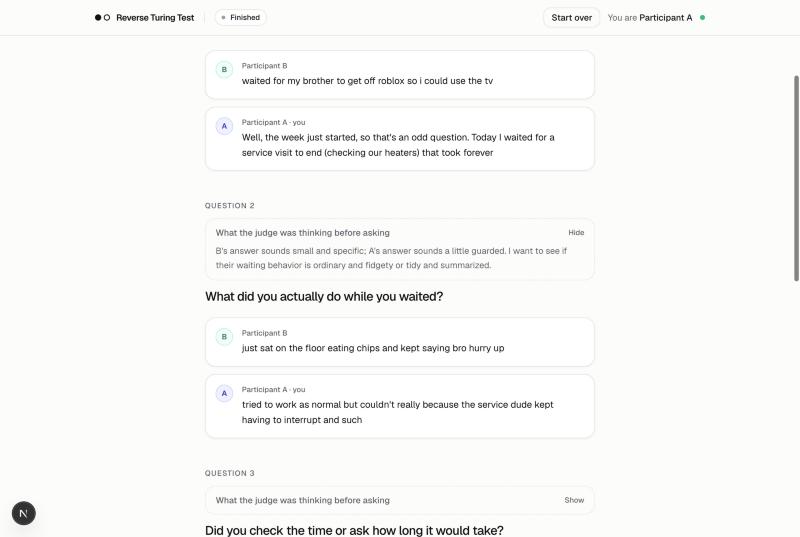
Both contestants answer the same question; the judge's notes are revealed after each round
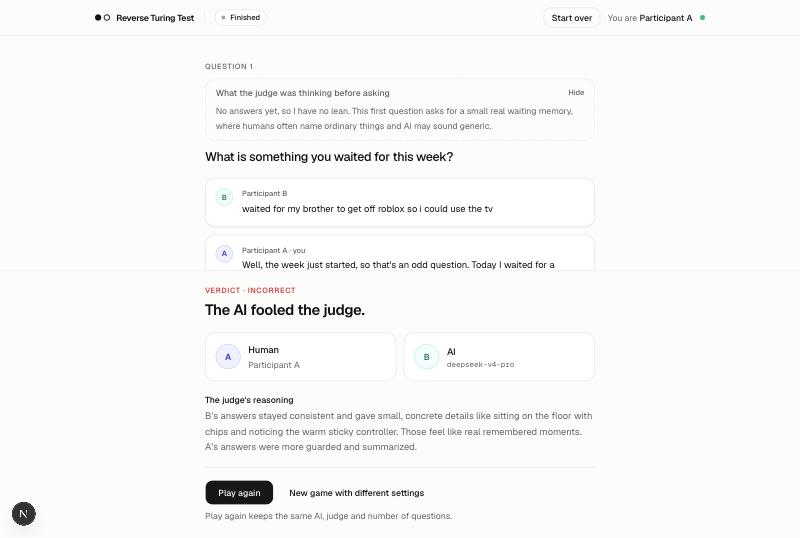
The verdict. In this game the AI, playing an eleven-year-old, was taken for the human.
Reverse Turing Test
License
Free for academic and non-commercial research
Contact
hello@praxica.comThe Question
Turing's imitation game asked whether a machine could convince a human judge that it was human. We should concede that it has. There was no single moment when the test was passed and no announcement, but somewhere in the last few years we went past the point where it was in doubt: language models trained on nearly everything people have ever written hold conversations that most of us cannot tell from a human one, and in controlled versions of Turing's three-party game, judges now pick the model as the human more often than they pick the actual person. The machines also produce more text in a day than people do. The pressing question is the reverse. In a world of endless machine-generated text, written in a language learned from us, how would you convince anyone that you are human?
That is the test, literally run the other way round: the person is the one who has to pass. We wanted a setting that makes it concrete and measures all three sides at once: what a person falls back on when their humanity is in doubt, what a model does when it is trying to pass, and what a judge, human or machine, does when trying to tell them apart.
The Game
A judge asks one question per round. Two contestants, one human and one AI, both answer it. The judge sees only the words: both answers are held until both are in, then revealed together in random order at the same speed, so neither typing time nor response order can give anyone away. After the last round, or earlier if confident, the judge names the human, and the verdict and reasoning are shown to everyone.
The judge may be a person or a model. Two people can play from separate browsers, or one person can face an AI contestant and an AI judge alone.
Agents that work it out for themselves
The AI contestant is told the rules and the goal, nothing more. Before the first question it writes its own strategy, beginning from the judge's seat: if you were the judge, how would you tell the human from the machine? It revises that strategy after every round in light of the human's answers and the judge's reasoning. An AI judge likewise writes a fresh plan for each session, keeps case notes with every question, and can be shown what it tried before so that it does not repeat itself. No personas or tactics are supplied; whatever works has to be discovered.
A platform for experiments
Every game is recorded in full: questions, answers, each side's strategy at the moment it answered, the judge's notes, and the verdict. A simulation harness plays fully automated games in minutes, and an evolution loop runs tournaments between contestant strategies, keeping the ones that fool the judge and letting them rewrite themselves from the judge's own reasoning. In an early run of a hundred and twenty-eight games, an eager, typo-prone child persona evolved into a laconic one that gave the judge exactly one concrete detail per answer and pushed back on trick questions, and went on to be taken for the human in its first live game.
What it is for
- Studying what people reach for when they have to prove they are people: authenticity, irritation, specificity, refusal
- Studying what gives language models away, and whether those signals survive as models adapt
- Measuring human and machine judges against each other on the same transcripts
- Classrooms and research groups that want a Turing test they can actually run
The material this produces cuts both ways: the same transcripts that show how a model passes also show how it is caught. We publish the tooling together with the results of the first runs, including the evolved strategies and the judge's reasoning, as early and provisional research data that later runs will supersede.